Description
Informations de base
| Code de produit | NGR-AA4034 |
| Échelle | 1:144 |
| Ajouté au catalogue: | 10.1.2024 |
| Tags: | Aggregat-A9 |
| Fabricant | Anigrand Craftswork |
| Entité responsable |
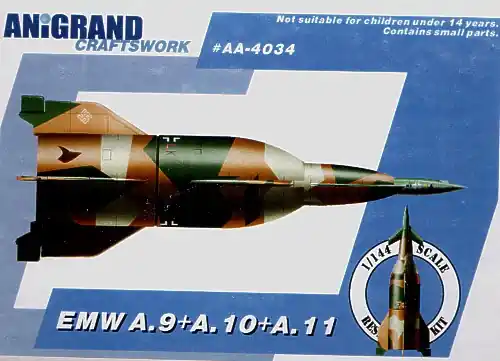
Kit includes:
68 resin parts + Clear-resin canopies, decal
Span: 114 mm x Height 303 mm
Also includes BONUS kits of the Fieseler Fi-166, Blohm-und-Voss MGRP, Skoda-Kauba P.14 and Bachem Ba-349 Natter
In 1939, following successes with the A-4 rocket, the von Braun team began thinking of a much more advanced aggregate series as the range of the A-4 was rather limited. One of the projects was the A-9/A-10 which was designed to carry a one-metric-ton payload from bases in France to New York City. The A-9/A-10 was composed of two stages: the winged/manned A-9 upper stage, and the A-10 boost rocket. The A-9 was partially recessed into the nose of the A-10. The thrust motor would burn for 50 seconds, taking the A-9 to 1200 m/s. Then the A-9 would separate and burn its engine, reaching an apogee of 55 km, followed by a long hypersonic glide in the atmosphere. The pilot was to be guided by radio beacons laid by U-boats in the Atlantic Ocean. After reaching the East-coast of America the pilot would lock in the target in an optical sight, then eject for rescue. In late 1944, work on the A-9/A-10 resumed under the code name « Projekt Amerika ». Designs beyond the A-9/A-10 were sketched out as well, adding an A-11 stage would have resulted in a true ICBM launcher. However, only a little data is available on the A-11 after the war.
Aggregat A9 est un projet de missile balistique allemand de la fin de la Seconde Guerre mondiale. On supposait que le poids de l’arme atteindrait 16 260 kilogrammes et que sa vitesse atteindrait 2 800 m / s! Le travail de conception de l’A9 s’est bien sûr inspiré de l’utilisation relativement réussie des missiles A4, plus largement connus sous le nom de V2. On supposait que la nouvelle fusée serait en mesure d’atteindre des cibles aux États-Unis et au Canada depuis l’Allemagne. Fait intéressant, il était initialement prévu d’utiliser des missiles A4 à cette fin, qui seraient transportés par des sous-marins de classe 21, mais l’idée a finalement été abandonnée. Il convient d’ajouter que la fusée A9 devait être contrôlée par le pilote jusqu’à la dernière étape du vol, qui communiquerait à son tour avec le sous-marin dans l’Atlantique pour corriger la route de vol. Juste avant que le missile n’atteigne la cible, le pilote devait en évacuer. L’arme n’a jamais été utilisée au combat et elle n’a pas dépassé le stade de la conception et de la maquette.
Erreur de la ? Signaler le problème